Free practice test →

Sharing the Road: People, Buses, Bikes

The single most misquoted rule in this group is the crosswalk. Minnesota does not ask you to yield to a pedestrian at an unsignalled crossing. Minn. Stat. 169.21, subd. 2 says you must stop, and you must stay stopped until they have cleared the lane you are in.

The school bus diagrams are worth slowing down on. Whether you may keep moving depends on whether the road is physically divided, and a painted center line is not a divider.

10 scenarios · free · no account needed · printable (Ctrl+P)
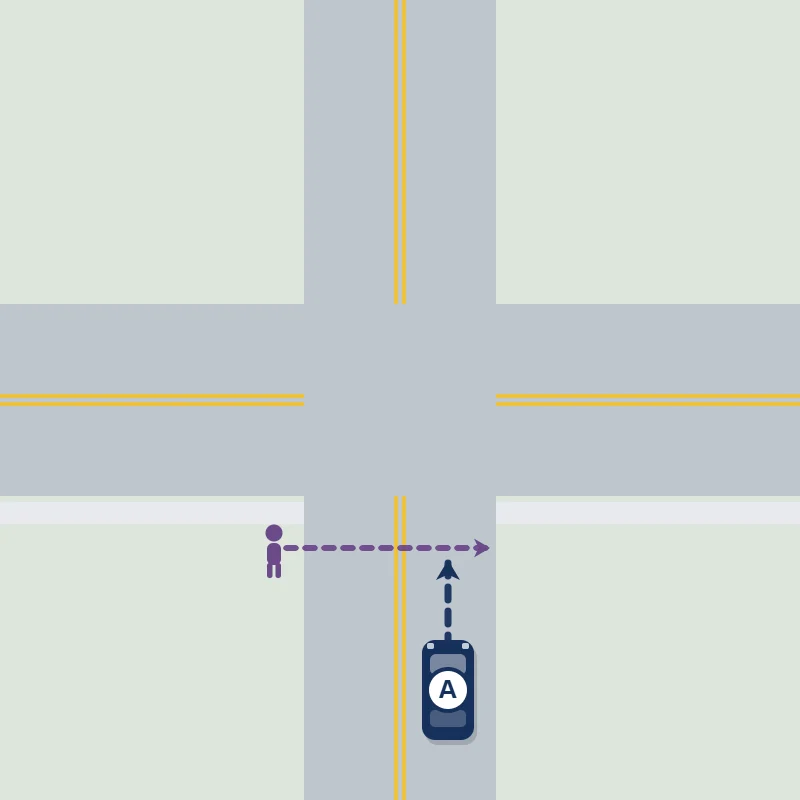
Top-down diagram: unmarked crosswalk
Scenario 1 · Unmarked crosswalk

Somebody steps off the curb to cross at the corner. There is no crosswalk painted on the road. What must A do?

  1. AStop; a corner is a crosswalk without paint
  2. BCarry on, as the crossing is not marked out
  3. CSlow down and steer round behind the person
  4. DSound the horn to warn them and keep going
Show the answer

A. Stop; a corner is a crosswalk without paint

Where a sidewalk meets the road at a junction there is a crosswalk whether or not anybody painted one. Your duty is the same as at a marked crossing: stop, and stay stopped until the person has cleared your lane.

Source: Minn. Stat. 169.21, subd. 2(a)
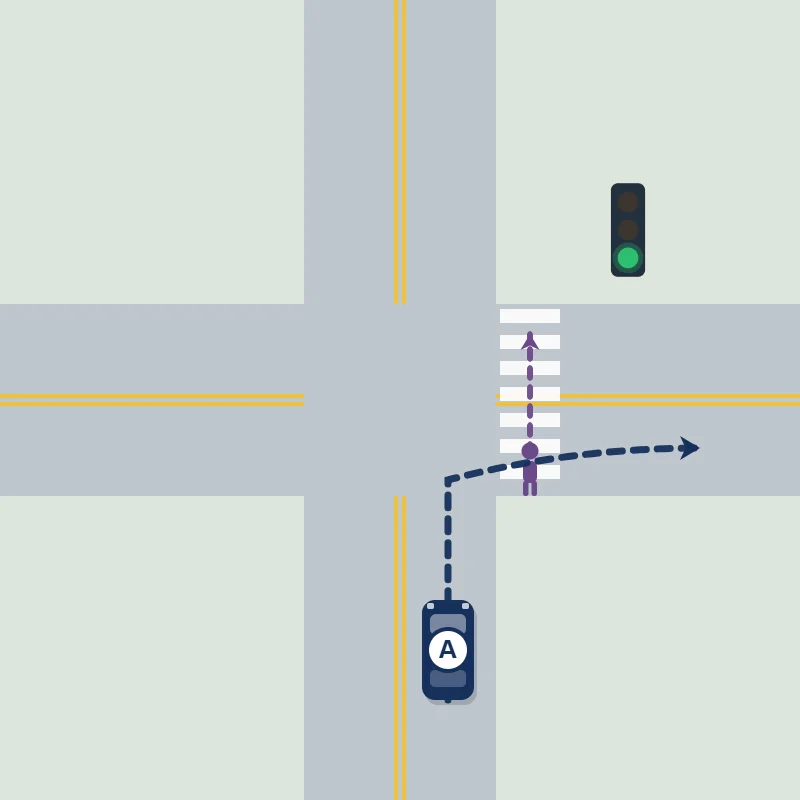
Top-down diagram: turning across a crossing
Scenario 2 · Turning across a crossing

A has a green light and is turning right. Somebody is already walking across the road A is turning into. Who goes first?

  1. AA, because A has the green light showing
  2. BThe person walking; A stops and waits
  3. CA, if A can complete the turn behind them
  4. DWhoever reaches the crosswalk line first
Show the answer

B. The person walking; A stops and waits

A green light gives you permission to enter the junction, not priority over people on foot. Turning drivers cross a crosswalk on the way out, and that is where most pedestrians get hit. Look right as you turn right.

Source: Minn. Stat. 169.21, subd. 2(a)
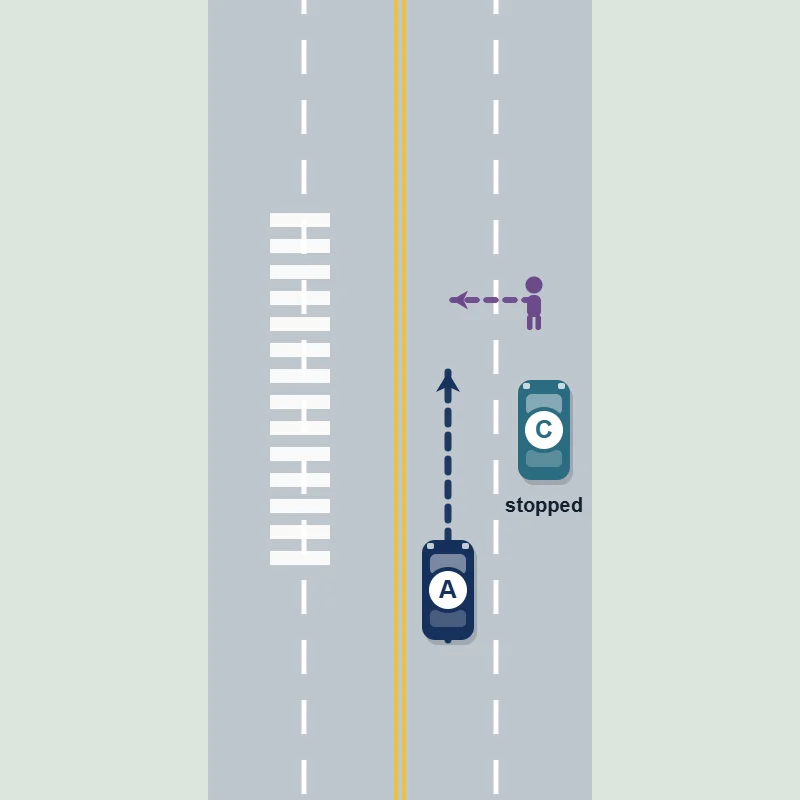
Top-down diagram: a car stopped at a crossing
Scenario 3 · A car stopped at a crossing

Car C has stopped at the crosswalk in the lane to A's right. A cannot see what C has stopped for. What must A do?

  1. AStop as well; passing C here is illegal
  2. BEase past slowly and watch for anyone
  3. CCarry on, as C's stop does not bind A
  4. DSound the horn and pass C with care
Show the answer

A. Stop as well; passing C here is illegal

When a vehicle has stopped at a crosswalk, a driver coming up behind or alongside may not pass it. C is screening somebody you cannot see yet. Minnesota also requires you to stop rather than slow, and to stay stopped until they have cleared your lane.

Source: Minn. Stat. 169.21, subd. 2(b)

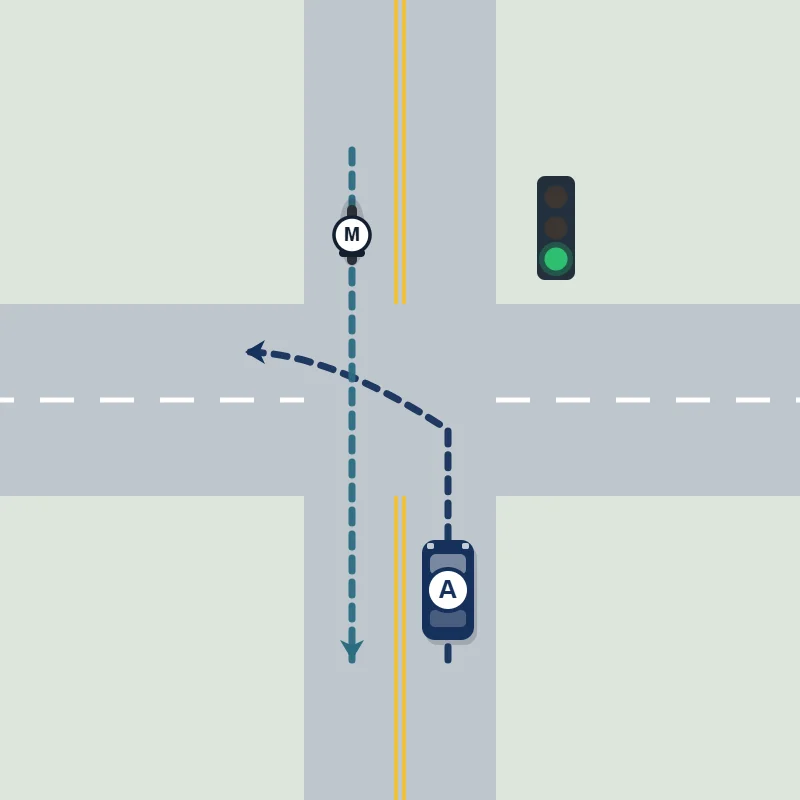
Top-down diagram: left turn across a motorcycle
Scenario 4 · Left turn across a motorcycle

A is turning left on a green circle. A motorcycle is coming straight the other way. What should A do?

  1. ATurn; a motorcycle can stop far quicker
  2. BWait for it, as you would for any vehicle
  3. CTurn if the rider has not signalled a turn
  4. DGo, because a bike takes up much less road
Show the answer

B. Wait for it, as you would for any vehicle

A motorcycle has exactly the same right of way as a car and is much harder to judge: it looks further away and slower than it is. Turning left in front of an oncoming rider is the most common car-motorcycle crash in Minnesota. Look twice, then wait.

Source: Minn. Stat. 169.20, subd. 2

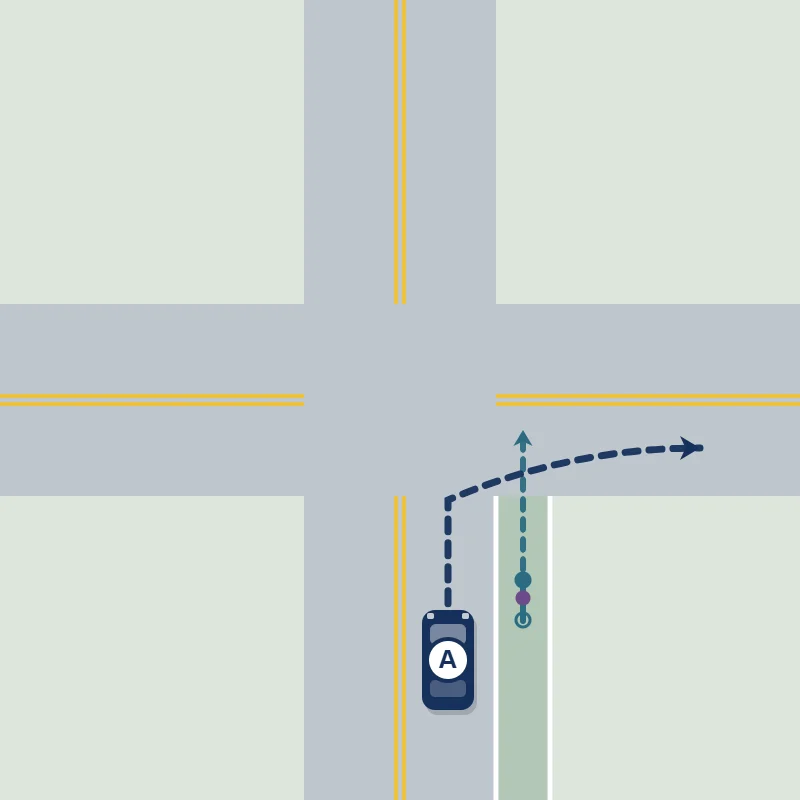
Top-down diagram: right turn across a bike lane
Scenario 5 · Right turn across a bike lane

A is turning right and a bike lane runs along the curb, with a cyclist coming up in it. What must A do?

  1. ATurn; the cyclist should slow down for A
  2. BGive way to the cyclist before turning
  3. CSound the horn to move the cyclist over
  4. DTurn wide so the cyclist can pass inside
Show the answer

B. Give way to the cyclist before turning

Your turn crosses the bike lane, so you give way to anybody already in it. Check your mirror and your blind spot on the right before you commit, because a bike coming up beside you is easy to miss.

Source: Minn. Stat. 169.19, subd. 1

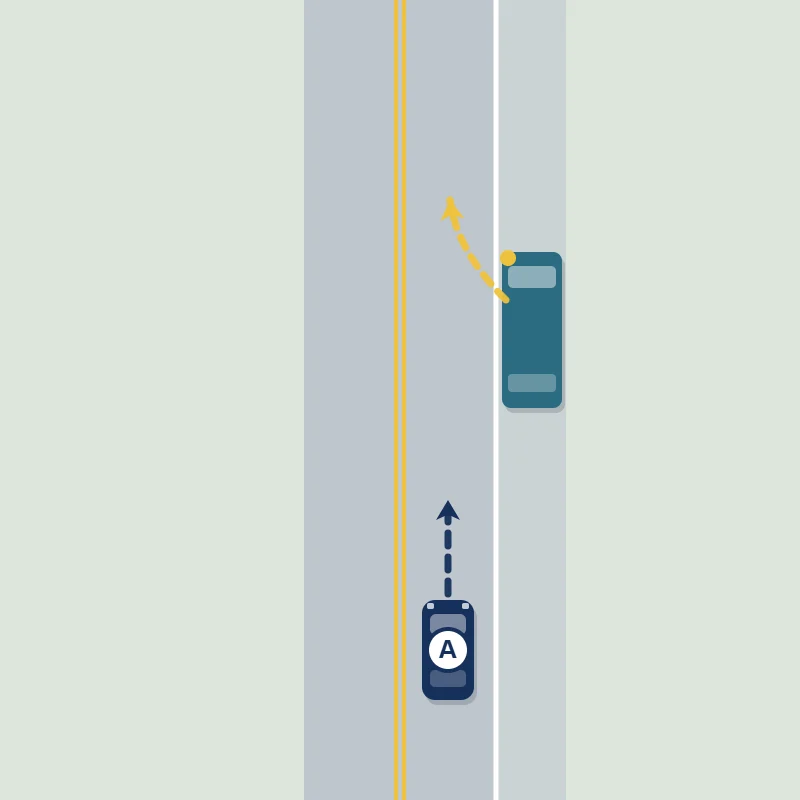
Top-down diagram: bus pulling back into traffic
Scenario 6 · Bus pulling back into traffic

A bus has stopped on the shoulder and is signaling to pull back into A's lane. What does Minnesota require of A?

  1. AGive way and let the bus back in
  2. BCarry on; the bus waits for a gap
  3. CGive way only if it is a school bus
  4. DSound the horn and pass it quickly
Show the answer

A. Give way and let the bus back in

Minnesota has a specific rule for this: when a bus signals to re-enter from a shoulder or a turn lane, following traffic gives way. Slow down and let it out. It is a rule many drivers have never heard of.

Source: Minn. Stat. 169.20, subd. 7

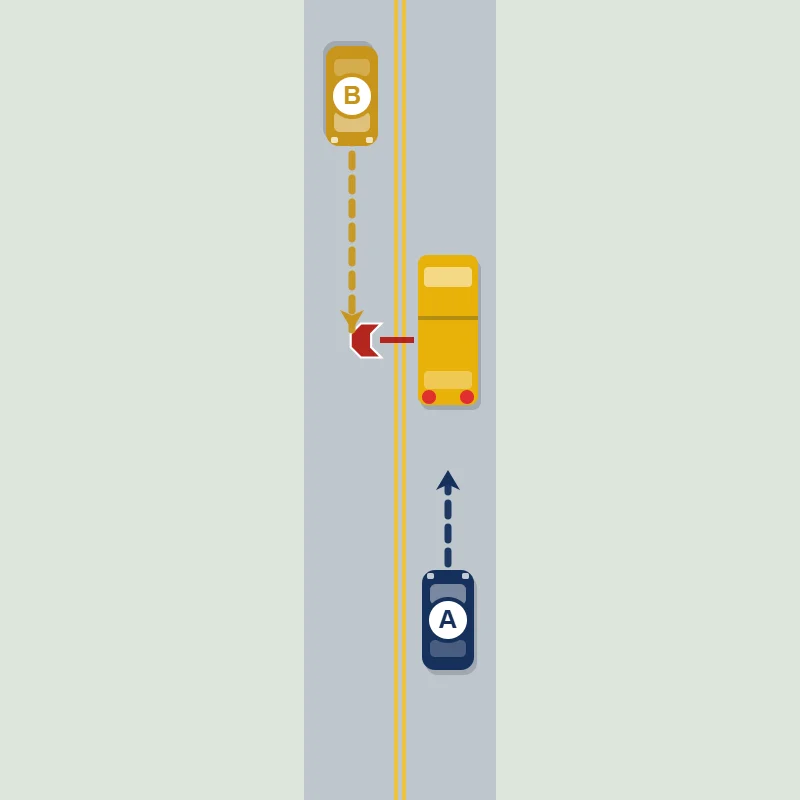
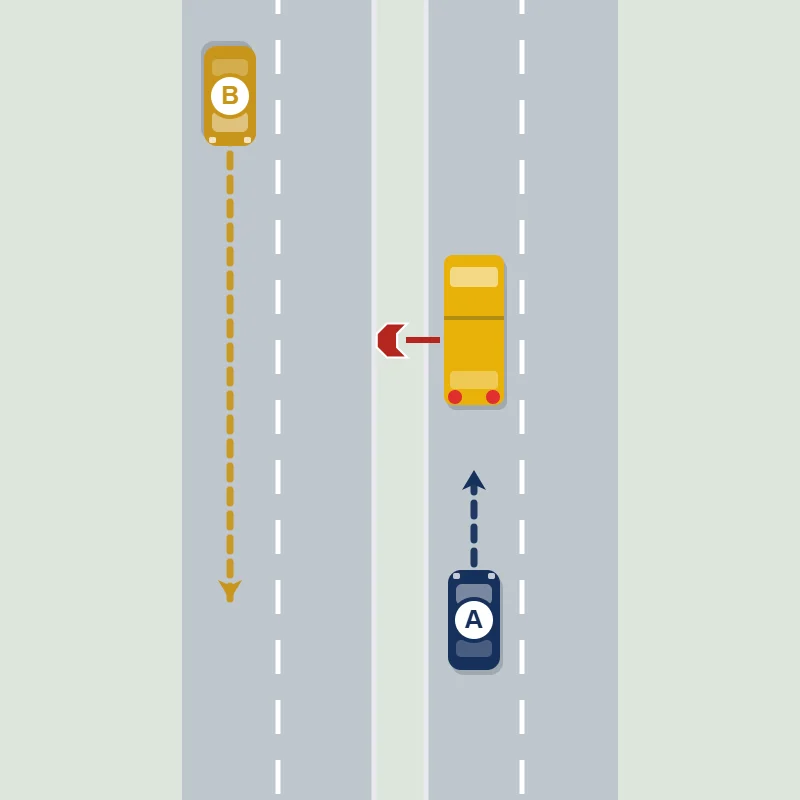
Top-down diagram: school bus, undivided road
Scenario 7 · School bus, undivided road

A school bus has stopped with red lights flashing and the stop arm out. The road is one lane each way with a painted center line. Who must stop?

  1. AJust A, who is traveling behind the bus
  2. BBoth A and B, from both directions
  3. CJust B, who is coming the other way
  4. DNeither, once the children are clear
Show the answer

B. Both A and B, from both directions

Paint does not divide a road. On an undivided road, traffic in both directions stops and stays stopped until the arm folds in and the lights go off. Since 2026 you must stop for the flashing reds even if the stop arm never swings out.

Source: Minn. Stat. 169.444, subd. 1

Top-down diagram: school bus, divided road
Scenario 8 · School bus, divided road

The same bus is stopped with its lights flashing, but now a raised median separates the two roadways. Who must stop?

  1. ABoth A and B still have to stop
  2. BOnly A, on the same side as the bus
  3. COnly B, who can see the children
  4. DNeither; a median ends the requirement
Show the answer

B. Only A, on the same side as the bus

A physical barrier, a raised median or a depressed median makes a road divided, and then only traffic on the bus's own roadway stops. A painted line or a center turn lane does not count. If you are not sure which kind of road you are on, stop.

Source: Minn. Stat. 169.444, subd. 4

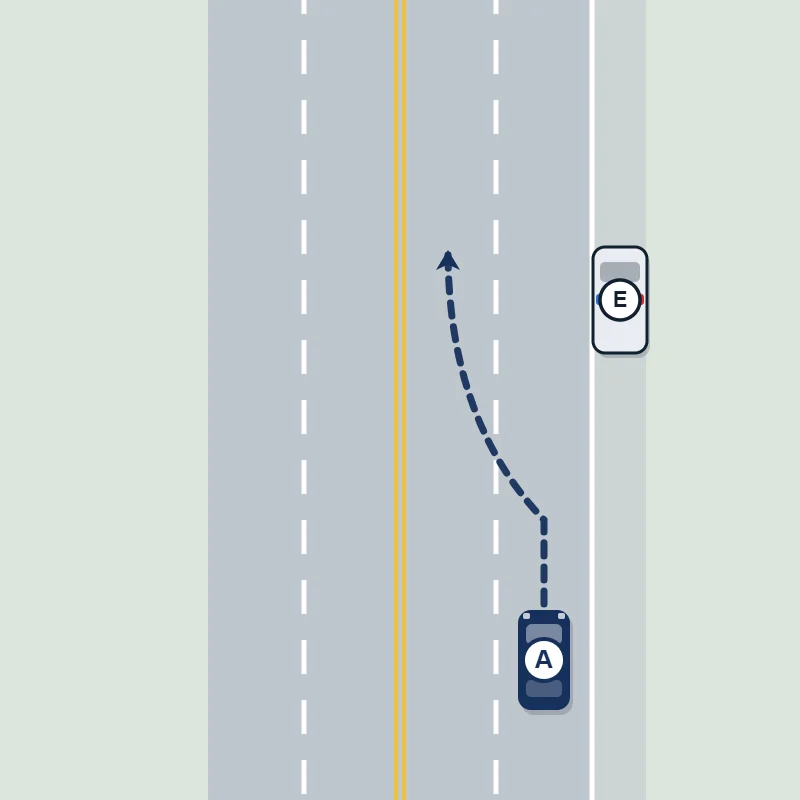
Top-down diagram: emergency vehicle behind you
Scenario 9 · Emergency vehicle behind you

An ambulance comes up behind A with lights and siren going. What must A do?

  1. ASpeed up to clear the road in front of it
  2. BPull right and stop until it has passed
  3. CBrake hard and stop right where A is now
  4. DMove left so it can pass on A's right side
Show the answer

B. Pull right and stop until it has passed

Pull as far right as you safely can and stop, clear of any junction. If you are already in the junction, drive through it first and then pull over. On a one-way street go to the nearest curb, which may be the left one.

Source: Minn. Stat. 169.20, subd. 5

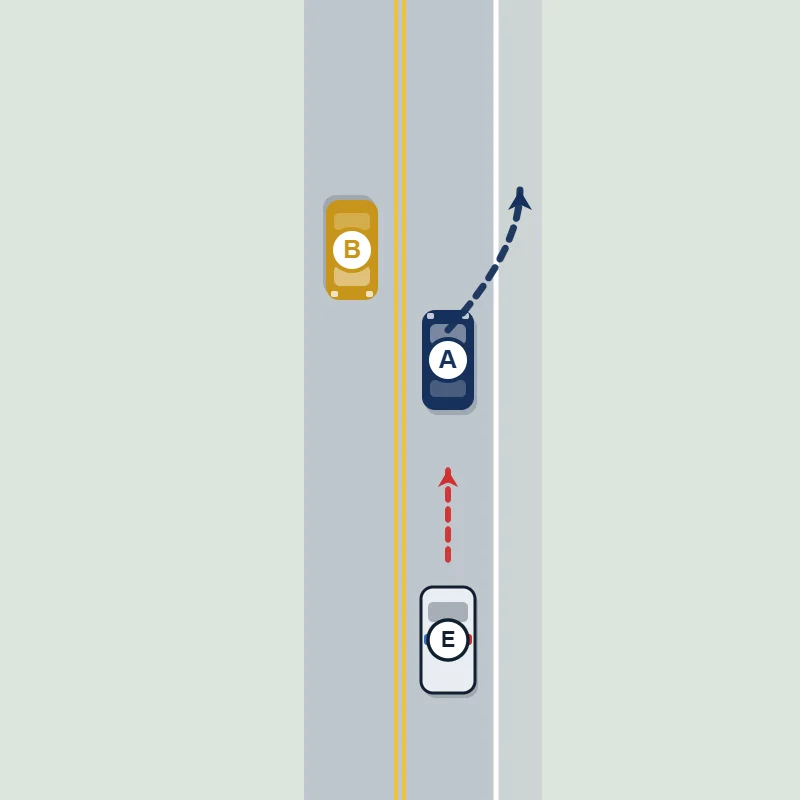
Top-down diagram: move over law
Scenario 10 · Move over law

A squad car is stopped on the right shoulder with its lights on. A is in the right-hand lane of a four-lane road. What does the law require?

  1. AMove over a lane if it can be done safely
  2. BCarry on at the limit, as it is on the shoulder
  3. CStop behind it and wait to be waved past
  4. DSound the horn as a warning, then pass
Show the answer

A. Move over a lane if it can be done safely

Move over a lane when you safely can. If you cannot, slow to a speed that is reasonable for the conditions until you are past. This covers tow trucks, road crews, utility vehicles and stalled cars, not just police.

Source: Minn. Stat. 169.18, subd. 11

More right-of-way diagrams

Practice these with a score

All 75 of these diagrams are built into the free NorthStar DE practice app, along with 600 more Minnesota permit questions. No account, no subscription, no ads.

Open the free practice test →