Free practice test →

Who Must Yield

Minnesota law never gives anybody the right of way. Every provision only ever says who has to give it up. That sounds like a lawyer splitting hairs until you are fourth into a four-way stop, and it turns out to be the whole difference between a driver who waits and a driver who assumes.

These are diagrams rather than photographs on purpose. A camera cannot show you that two cars arrived at the same moment, and it cannot show you where each driver intends to go. Both of those facts decide the answer. The governing rules are in Minn. Stat. 169.20.

16 scenarios · free · no account needed · printable (Ctrl+P)
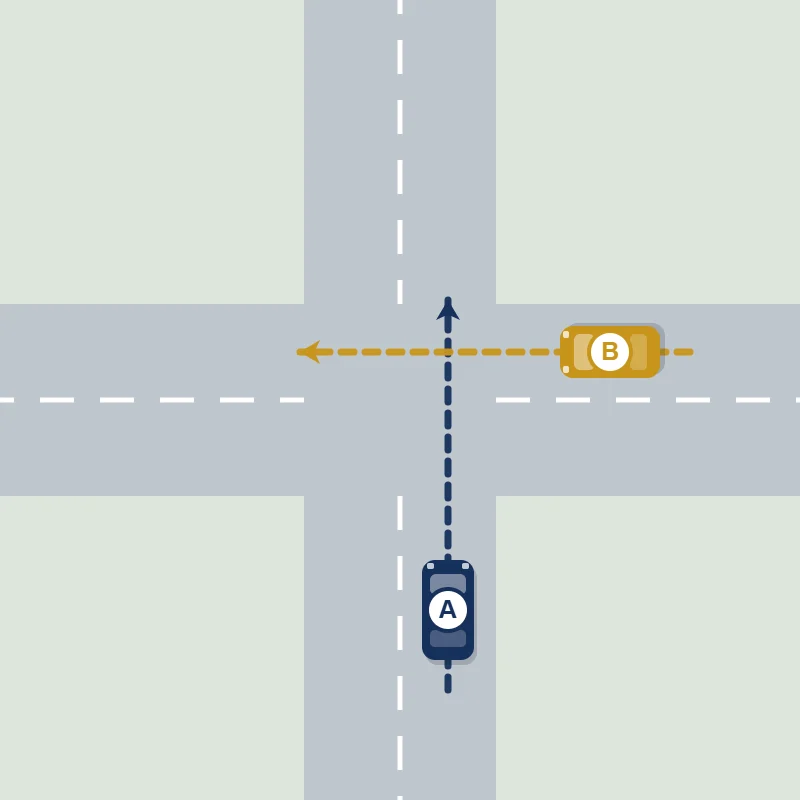
Top-down diagram: uncontrolled intersection
Scenario 1 · Uncontrolled intersection

Neither road has a sign or a signal. A and B reach the crossing at about the same moment. Who has to yield?

  1. AA yields, because B is on A's right
  2. BB yields, because A is going straight on
  3. CB yields, because A got to the line first
  4. DNeither; the wider road always has priority
Show the answer

A. A yields, because B is on A's right

The driver on the left yields to the driver on the right. B is on A's right, so A waits. Two details worth knowing: the law says at approximately the same time, not at exactly the same instant, and a driver who is speeding gives up any right of way they would otherwise have had.

Source: Minn. Stat. 169.20, subd. 1(a)
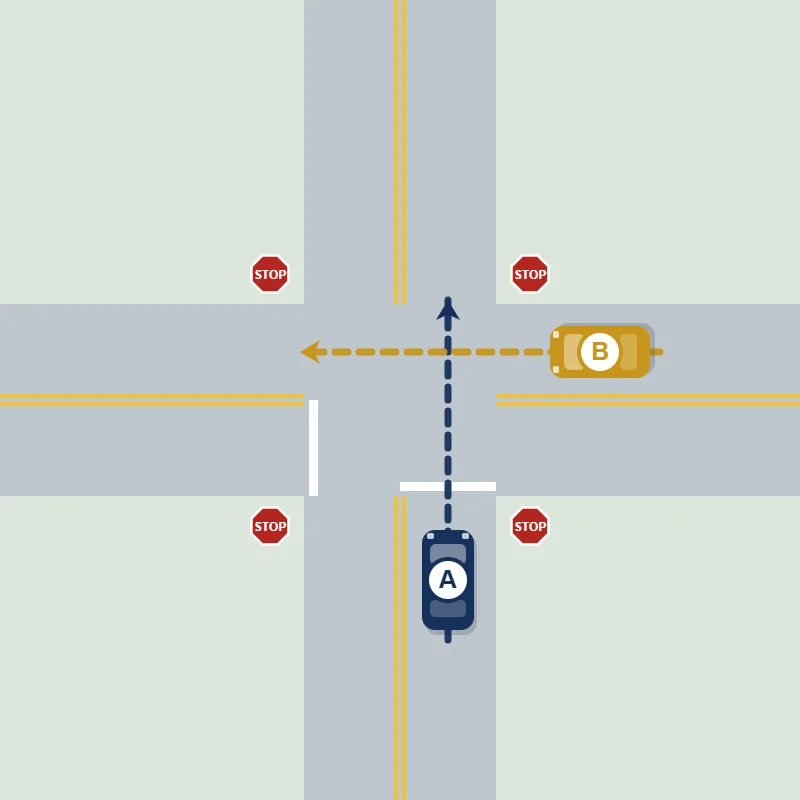
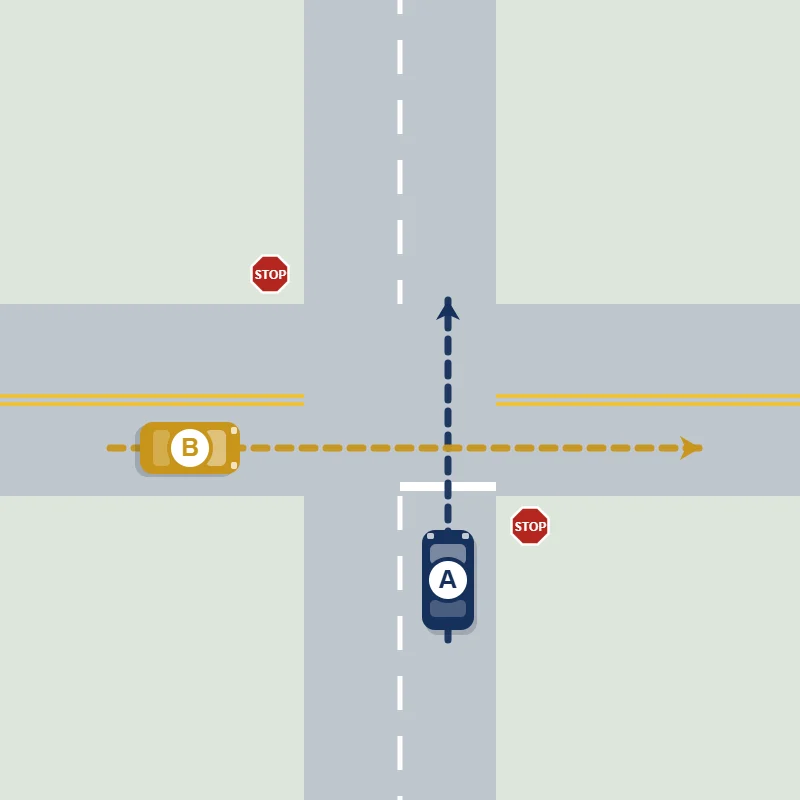
Top-down diagram: all-way stop, side approaches
Scenario 2 · All-way stop, side approaches

Both drivers stop at the all-way stop and reach the line together. B is coming from A's right. Who goes first?

  1. AB goes; the driver on the left yields
  2. BA goes; going straight beats turning
  3. CA goes, because A is on the busier road
  4. DEither; the rule does not cover this case
Show the answer

A. B goes; the driver on the left yields

At an all-way stop the same left-yields-to-right rule applies as at an uncontrolled crossing. A is on B's left, so A waits. Make eye contact before you move: the rule only works if the other driver knows it too.

Source: Minn. Stat. 169.20, subd. 1(b)

Top-down diagram: all-way stop, left vs straight
Scenario 3 · All-way stop, left vs straight

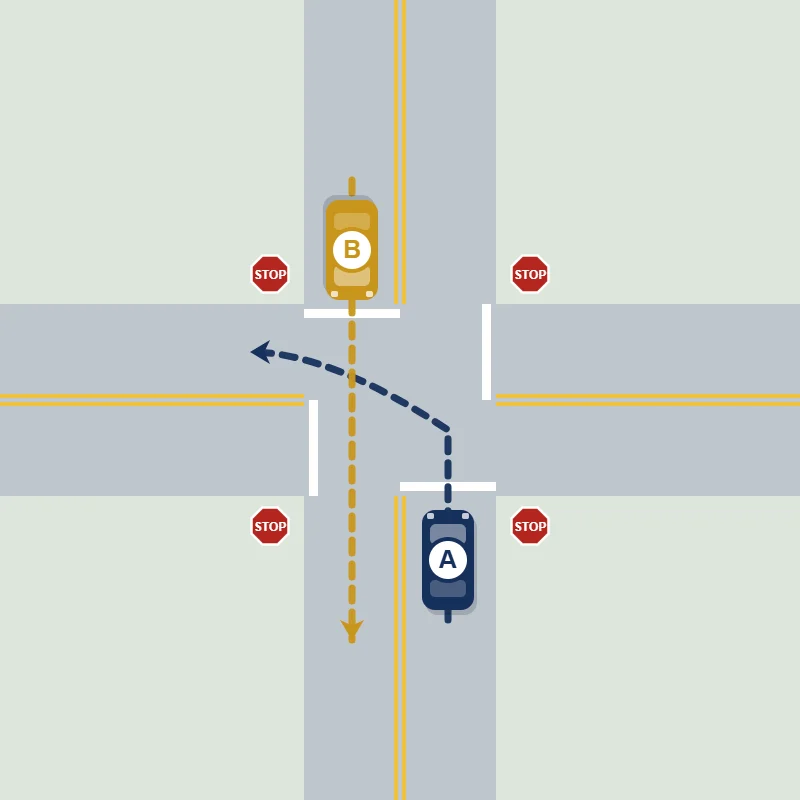
Both drivers stop, then move off together. A is turning left and B is coming straight the other way. Who goes first?

  1. AB goes; a driver turning left has to yield
  2. BA goes; the left turn clears the box sooner
  3. CA goes, because B is over on A's right side
  4. DEither may go; yield-to-the-right settles it
Show the answer

A. B goes; a driver turning left has to yield

Going straight beats turning. Yield-to-the-right cannot settle this one, because when two cars face each other neither is to the right of the other. The left-turn rule decides it: you yield to anything coming the other way that is close enough to be a hazard.

Source: Minn. Stat. 169.20, subd. 1(b); subd. 2

Top-down diagram: all-way stop, one car already there
Scenario 4 · All-way stop, one car already there

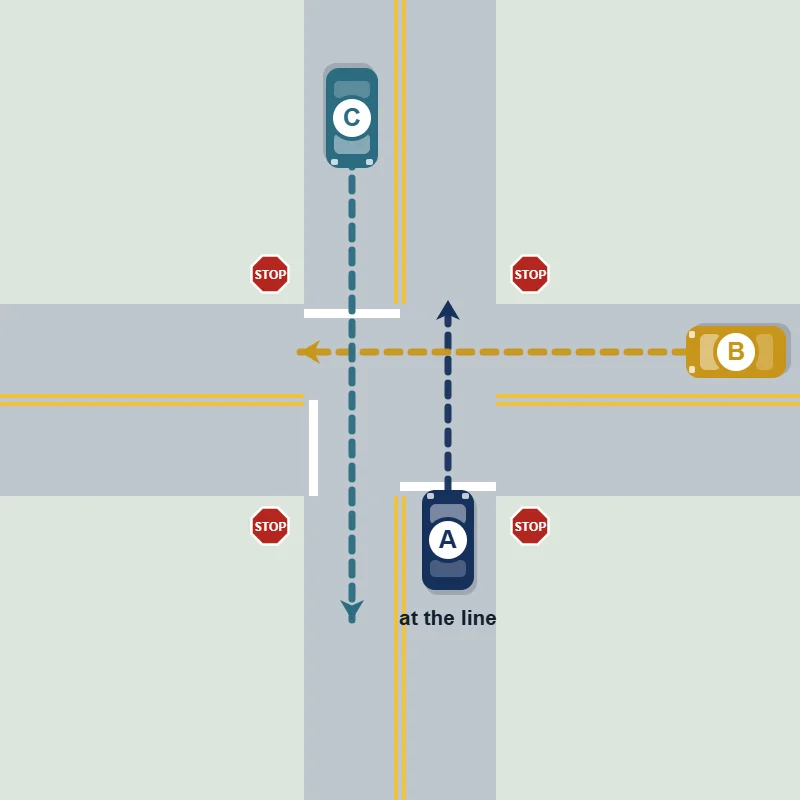
Three cars come to the all-way stop. A is already stopped at the line; B and C are still well back. Who goes first?

  1. AA, because A reached the line first
  2. BC, because C is on B's right side
  3. CB, because B is on A's right side
  4. DNobody until all three have fully stopped
Show the answer

A. A, because A reached the line first

Whoever gets there first goes first, and A is plainly there first. Yield-to-the-right is the tie-breaker for drivers arriving together, not a rule that overrides someone already waiting. After A clears, B and C sort themselves out by who is on whose right.

Source: Minn. Stat. 169.20, subd. 1(b)

Top-down diagram: all-way stop, everyone turning right
Scenario 5 · All-way stop, everyone turning right

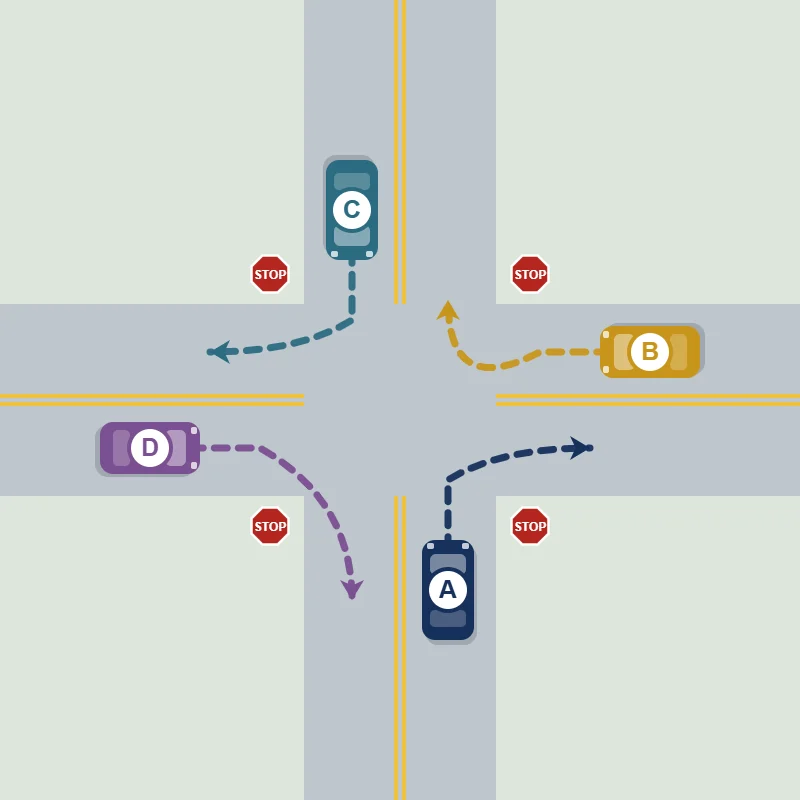
All four drivers reach the all-way stop together, and every one of them is turning right. What happens?

  1. AAll four can go; none of their paths cross
  2. BOnly the driver furthest right may move
  3. CThey go one at a time, clockwise round
  4. DNobody may move until three have backed off
Show the answer

A. All four can go; none of their paths cross

A right turn keeps you on your own side of the road, so four right turns never cross one another. Once everyone has stopped and it is clear that all four are turning right, all four can move together. Signal early so the others can read your intention.

Source: Minn. Stat. 169.20, subd. 1(b)

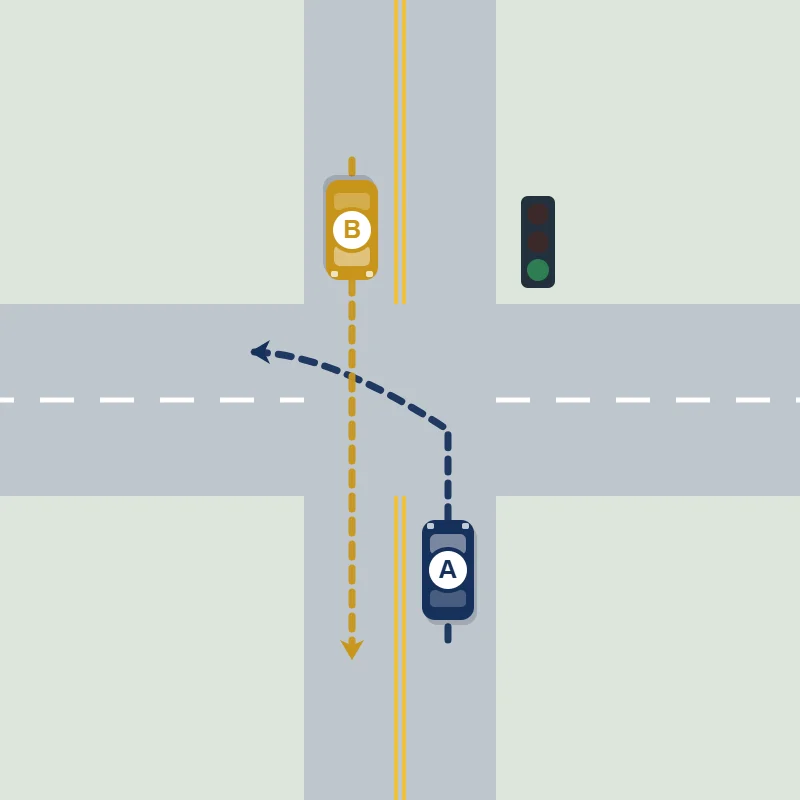
Top-down diagram: left turn, no signs
Scenario 6 · Left turn, no signs

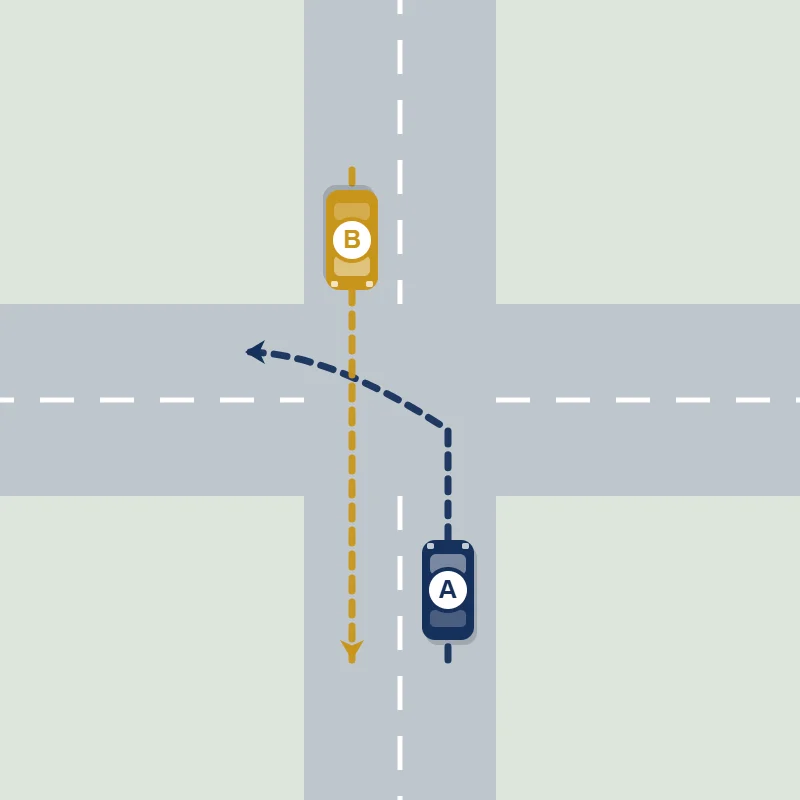
There are no signs or signals at all. A is turning left and B is coming straight from the other direction. Who yields?

  1. AA yields; a turning driver gives way
  2. BB yields; A started the turn already
  3. CNeither, if both are traveling slowly
  4. DB yields, because A is on B's right
Show the answer

A. A yields; a turning driver gives way

The left-turn rule does not need a sign or a signal to apply. Anywhere you turn left across traffic coming the other way, you give way to it, including turning into a driveway or an alley.

Source: Minn. Stat. 169.20, subd. 2

Top-down diagram: left turn on a green circle
Scenario 7 · Left turn on a green circle

The light showing for both drivers is a solid green circle, not an arrow. A wants to turn left and B is coming straight on. What must A do?

  1. ATurn now, since a green circle allows turns
  2. BWait for a gap; oncoming traffic comes first
  3. CEdge out and turn as soon as B begins to slow
  4. DWait for a green arrow before turning at all
Show the answer

B. Wait for a gap; oncoming traffic comes first

A green circle lets you turn but gives you no protection: you yield to anything coming the other way that is close enough to be a hazard. You may wait in the intersection for a gap, but do not turn the wheels until you go.

Source: Minn. Stat. 169.20, subd. 2

Top-down diagram: stop sign on one road only
Scenario 8 · Stop sign on one road only

A has a stop sign; B is on the through road and has none. A stopped a moment before B appeared. Who goes first?

  1. AA, because A stopped there first
  2. BB; stopping does not buy a turn to go
  3. CA, as long as A signals the intention
  4. DWhichever of them is traveling slower
Show the answer

B. B; stopping does not buy a turn to go

Stopping is only the first half of the job. After the stop you still give way to everything on the through road, however long you have been waiting. Cross-traffic-does-not-stop plaques exist because this catches people out.

Source: Minn. Stat. 169.20, subd. 3(a)

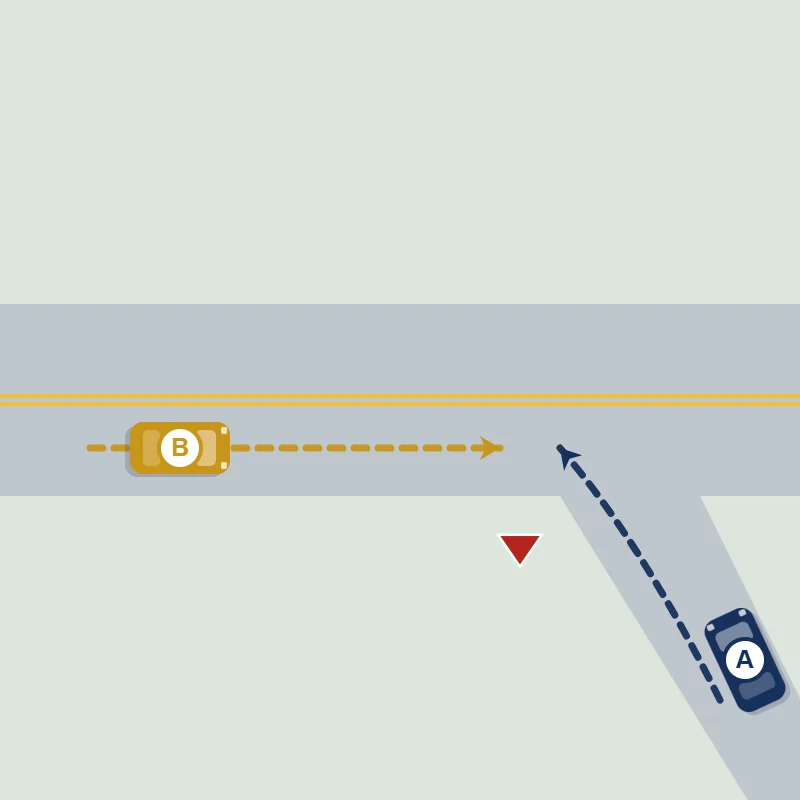
Top-down diagram: yield sign on a side road
Scenario 9 · Yield sign on a side road

A is coming down a side road with a yield sign. B is already on the main road. What does the yield sign require of A?

  1. AStop fully, every time, then pull out
  2. BSlow, and stop if needed, to let B pass
  3. CSound the horn, then merge in ahead of B
  4. DKeep speed up and merge in front of B
Show the answer

B. Slow, and stop if needed, to let B pass

A yield sign means give way, not always stop. Slow down enough to judge the gap and be ready to stop if one is not there. A stop is required only when you cannot safely join without it.

Source: MN Driver's Manual, Ch. 3 — Yield signs

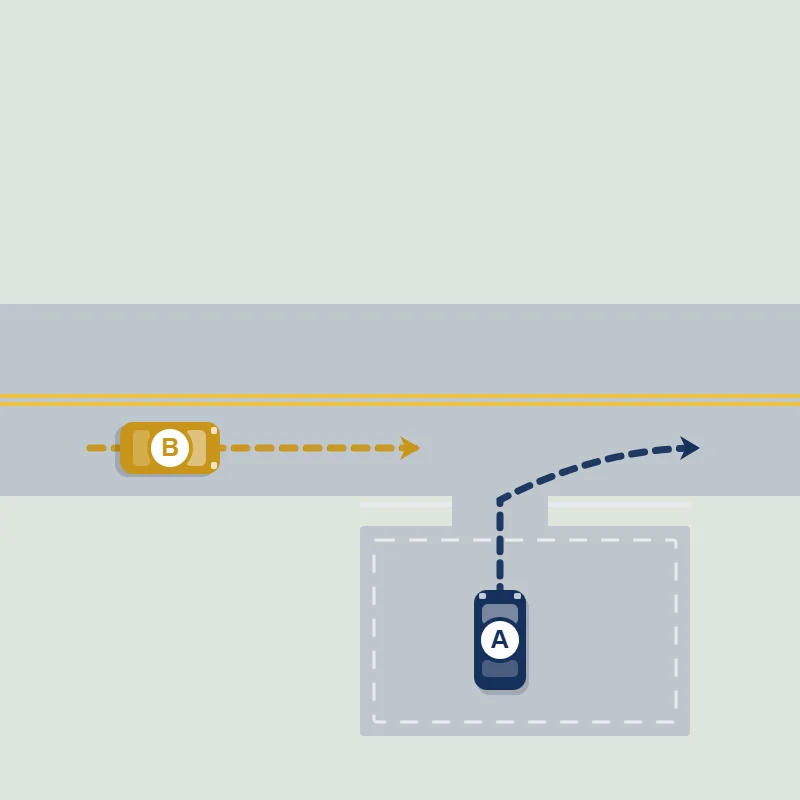
Top-down diagram: pulling out of a parking lot
Scenario 10 · Pulling out of a parking lot

A is leaving a parking lot and joining the road. B is already on the road. What must A do?

  1. AStop, then give way to traffic and people
  2. BMerge straight out, as B has room to slow
  3. CGive way to cars, but people on foot wait
  4. DGo if A can reach the gap before B does
Show the answer

A. Stop, then give way to traffic and people

Coming out of a lot, alley or driveway you stop first, then give way to everything already on the road, and to anybody on the sidewalk you cross on the way out. The sidewalk counts as a crosswalk even with no paint on it.

Source: Minn. Stat. 169.20, subd. 4

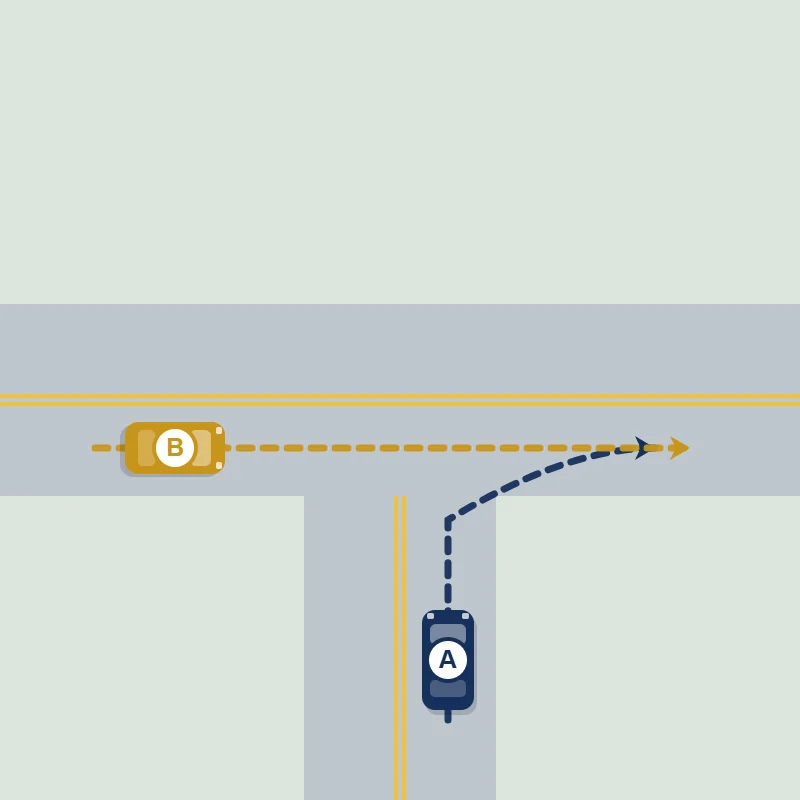
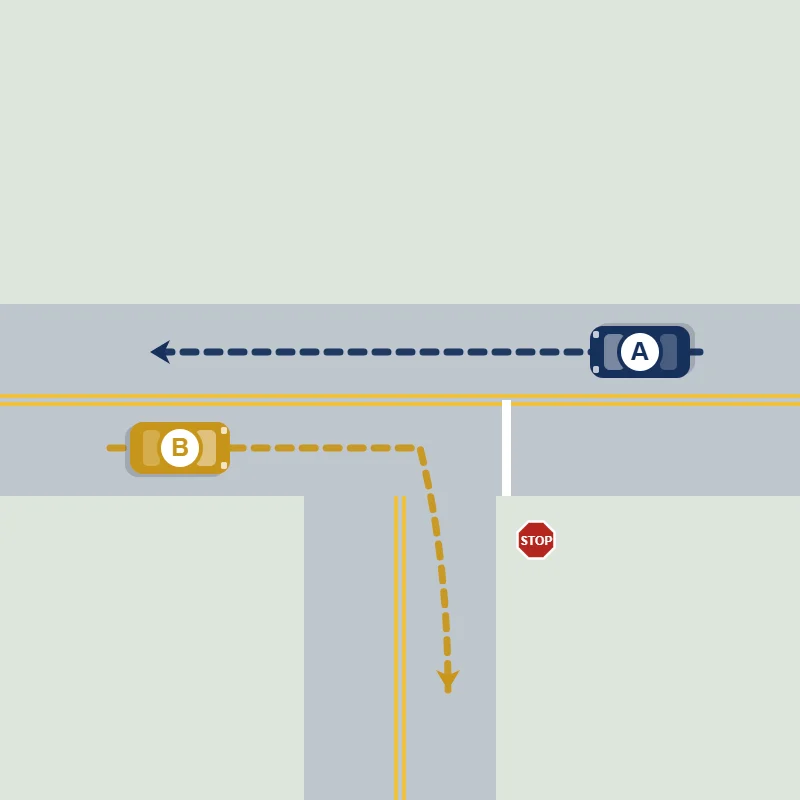
Top-down diagram: uncontrolled t-intersection
Scenario 11 · Uncontrolled T-intersection

A's road ends here, so A has to turn. B is carrying straight on through. There are no signs at all. Who yields?

  1. AA may go, because B is over on A's left
  2. BA yields, because A is the one who must turn
  3. CB yields, since the through road is wider
  4. DNeither of them, as long as both slow down
Show the answer

B. A yields, because A is the one who must turn

Minnesota writes this one down explicitly: at an uncontrolled T, the driver who is required to turn yields to cross traffic. Which side the other car is on does not matter. Most states have no T rule and fall back on yield-to-the-right, which gives the wrong answer here.

Source: Minn. Stat. 169.20, subd. 1(c)

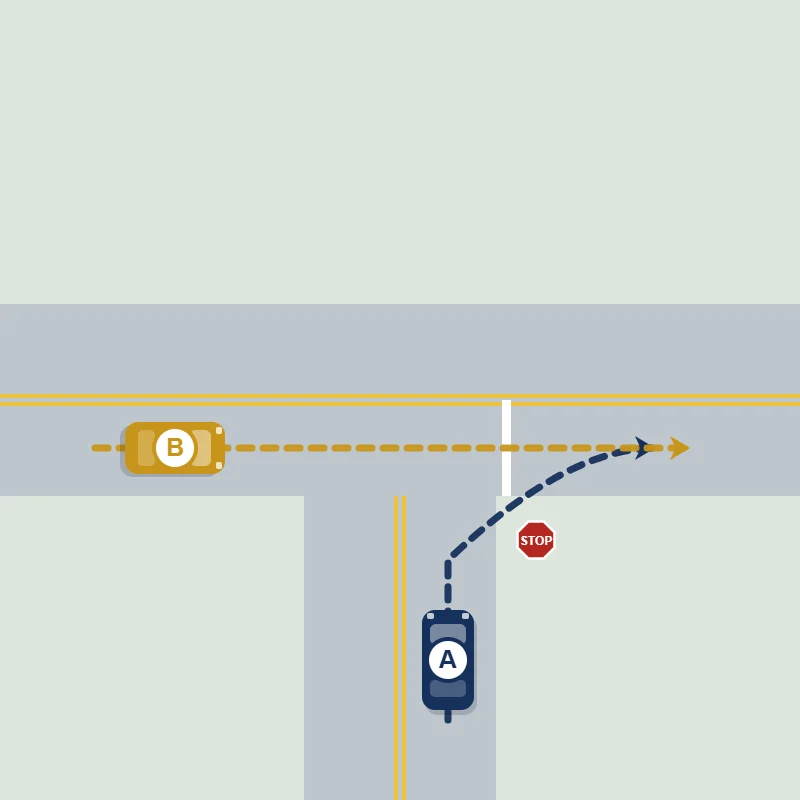
Top-down diagram: t-intersection with a stop sign
Scenario 12 · T-intersection with a stop sign

A's road ends at a T and A has a stop sign. B is on the through road with no sign. What does A do after stopping?

  1. AGive way to B, then turn when it is clear
  2. BTurn at once, having already come to a stop
  3. CGive way only if B has a turn signal showing
  4. DWait for B to flash the headlights through
Show the answer

A. Give way to B, then turn when it is clear

The stop sign and the T rule point the same way here. Stop at the line, then give way to everything on the through road before you turn. The stop is the beginning of your duty, not the end of it.

Source: Minn. Stat. 169.20, subd. 3(b)

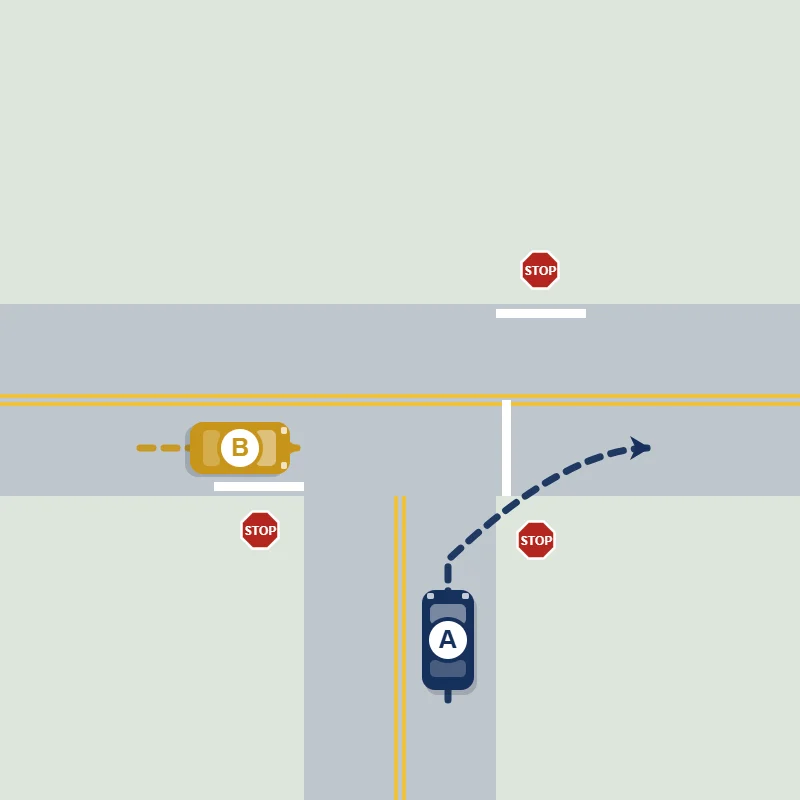
Top-down diagram: t-intersection, all-way stop
Scenario 13 · T-intersection, all-way stop

Every approach to this T has a stop sign. A and B stop at the same moment. Which rule decides who goes first?

  1. AWhoever is making the shorter turn goes first
  2. BThe driver who has the other vehicle on their right must yield
  3. CThe driver already on the through road always goes first
  4. DAt a T intersection nobody has to give way
Show the answer

B. The driver who has the other vehicle on their right must yield

Stop signs on every approach make this an ordinary all-way stop, and the T shape stops mattering. First to arrive goes first; when two arrive together, the driver with the other vehicle on their right is the one who yields. The T rule — the road that ends gives way — only governs an approach that is NOT stop-controlled.

Source: Minn. Stat. 169.20, subd. 1(b)

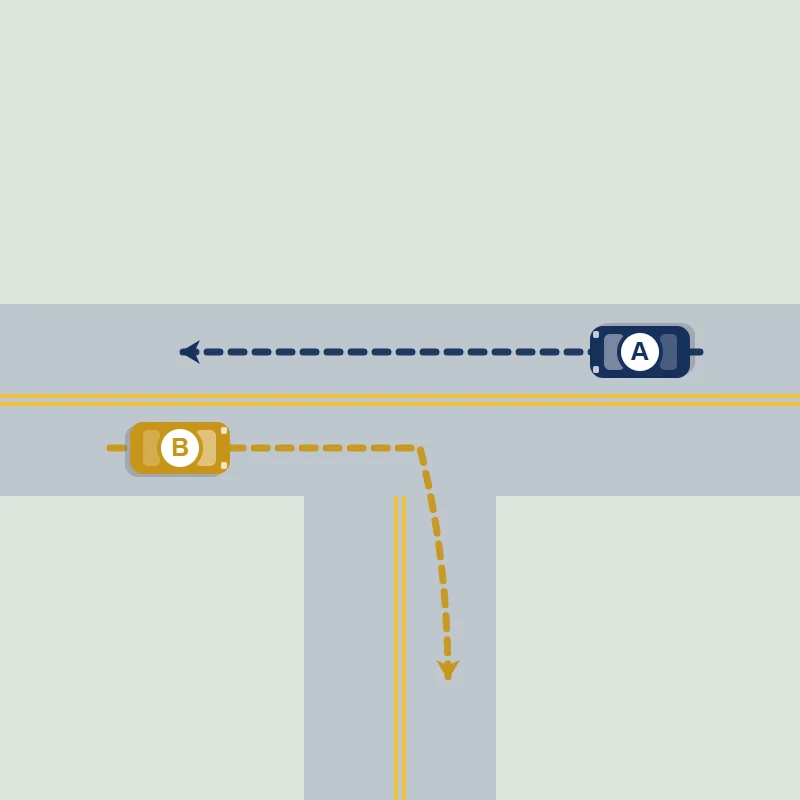
Top-down diagram: right turn into a side road
Scenario 14 · Right turn into a side road

B is on the through road and turns right into the side road. A is coming the other way on the through road. Who yields?

  1. ANeither — B's right turn never crosses A's path
  2. BB yields, because every turn gives way to oncoming
  3. CA yields, since B is leaving the main road
  4. DBoth must stop before entering the side road
Show the answer

A. Neither — B's right turn never crosses A's path

Neither. B turns right out of its own lane straight into the side road, and A is on the far side of the center line traveling the other way — the two paths never meet. A LEFT turn would be the opposite story, because that one has to cross the oncoming lane. B still has to signal, hug the right through the turn, and yield to anyone in the crosswalk.

Source: Minn. Stat. 169.19, subd. 1

Top-down diagram: who a stop sign binds
Scenario 15 · Who a stop sign binds

The side road has a stop sign. B is turning left off the through road into it, and A is coming the other way. Does that stop sign change who yields between A and B?

  1. ANo; B still gives way to oncoming A
  2. BYes; the sign makes A give way to B
  3. CYes; it means neither of them yields
  4. DNo; A gives way as B signalled first
Show the answer

A. No; B still gives way to oncoming A

A stop sign binds the driver who faces it, and nobody else. It tells traffic coming out of the side road to stop; it says nothing about A and B, who are both on the through road. Between those two the ordinary left-turn rule decides, so B waits.

Source: Minn. Stat. 169.20, subd. 3(b)

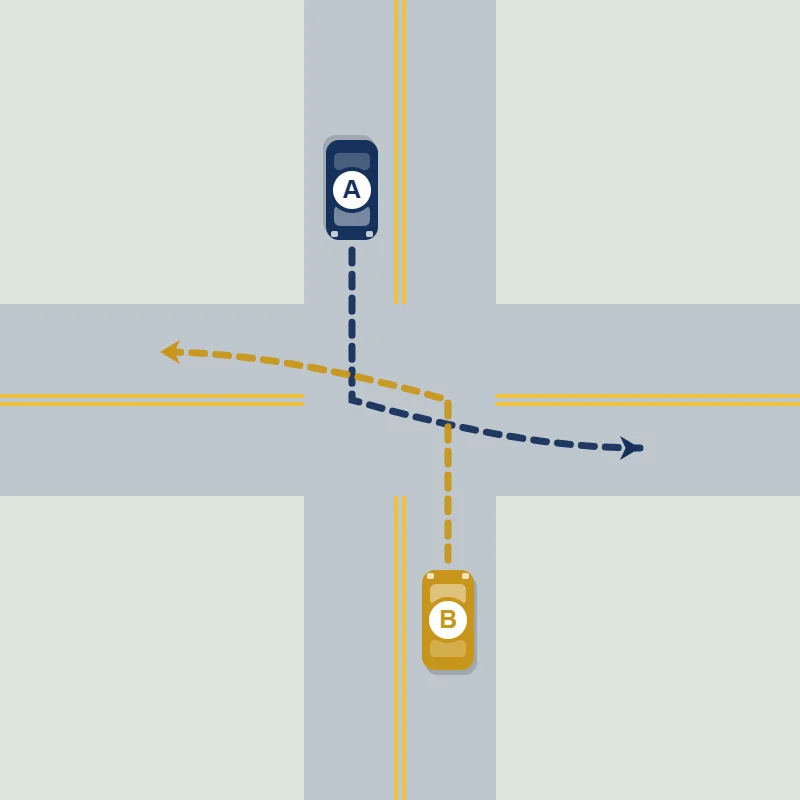
Top-down diagram: two approaching left turns
Scenario 16 · Two approaching left turns

A and B are facing each other and both are turning left at the same time. What is the thing to watch for?

  1. ANothing; two left turns never conflict
  2. BEach car hides the other's view of oncoming
  3. CThe car on the right has to go first here
  4. DBoth must wait for a green arrow to appear
Show the answer

B. Each car hides the other's view of oncoming

Two opposing left turns can go together, because neither ends up where the other is heading. The danger is that each car blocks the other's view of traffic coming straight through, and of anyone in the crosswalk you are turning across. Ease out and keep looking.

Source: Minn. Stat. 169.20, subd. 2

More right-of-way diagrams

Practice these with a score

All 75 of these diagrams are built into the free NorthStar DE practice app, along with 600 more Minnesota permit questions. No account, no subscription, no ads.

Open the free practice test →